



Every executive I've worked with this year has faced the same pressure:
"We've made the investment in AI. Now make it count!"
But that is not the place to start.
In the first half of 2025, I worked closely with leadership teams navigating AI transformation. The focus was not just on experimentation. It was about moving from fragmented pilots to sustainable execution.
Across those conversations, one thing became clear:
"Only 25 percent of AI initiatives have delivered the expected ROI, and just 16 percent have successfully scaled across the enterprise." BCG, 2025
Most organizations aren't falling behind because of missing technology. They're falling behind because their structure wasn't built to adapt. Some moved quickly. Others stalled. The ones that broke through weren't just adopting tools. They were redesigning how they work.
That insight led to the creation of the Apex Pyramid, a framework for execution at scale, built from the ground up for today's environment.
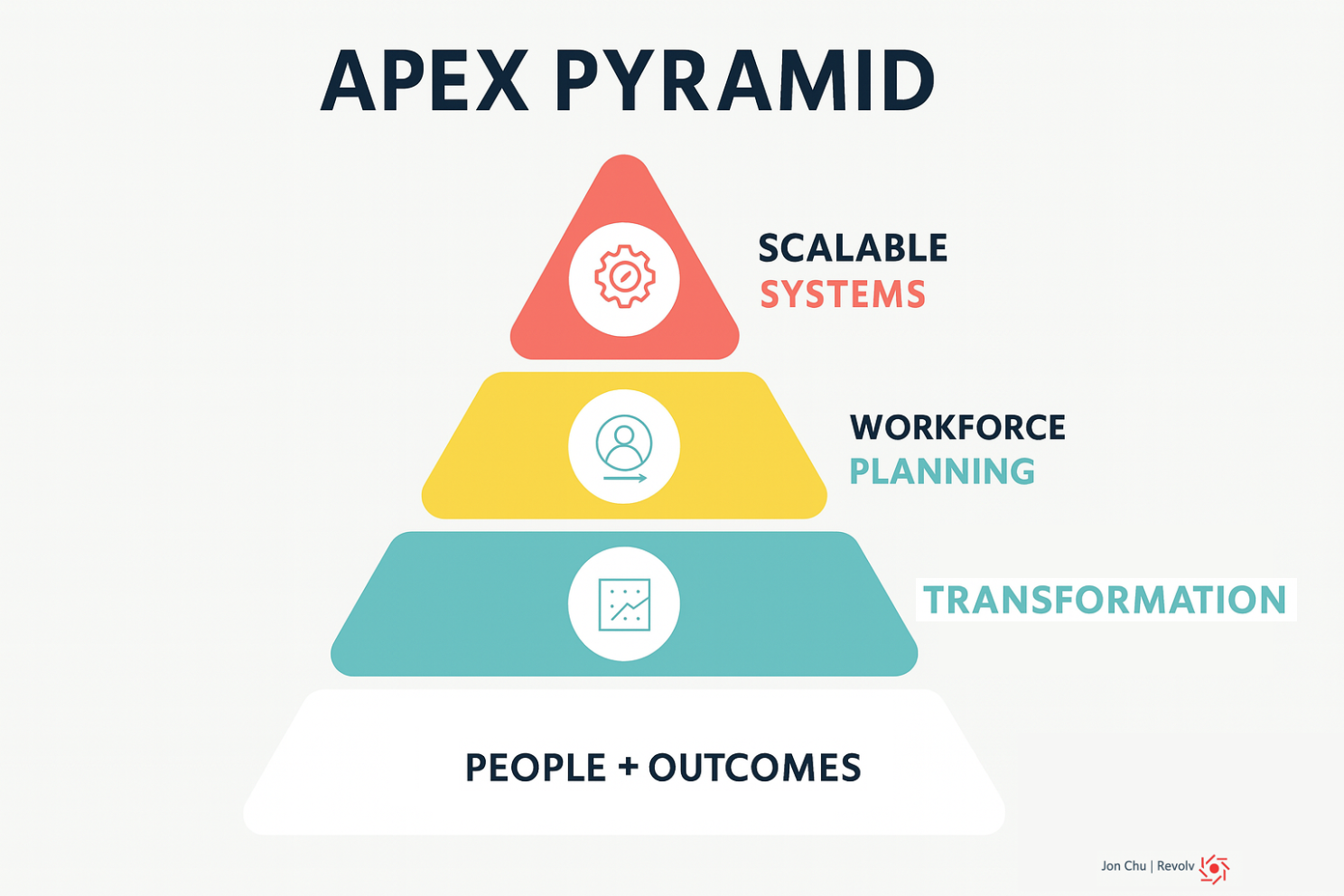
Every organization's transformation looks different. But beneath the surface, the patterns are strikingly similar.
The organizations breaking through follow a clear pattern:
Layer 1: People + Outcomes = Transformation
Before systems and workflows, there must be trust and clarity.
Organizations that scale well start here:
- Clear ownership of outcomes
- Decentralized decision rights
- Alignment on what "good" looks like
AI doesn't fix ambiguity. It amplifies whatever already exists. If your foundation is misaligned, no tech will fix it.
Layer 2: Workforce Planning That Adapts
This is where structure becomes a lever, not a blocker.
Most orgs rely on static hierarchies designed for predictability.
High-performing teams re-architect their workforce to match how work actually flows.
The defining characteristics:
- Org design around real workflows, not legacy functions
- Clear definition of product ownership
- Strategic mix of full-time, contingent, and AI-augmented roles
- Innovation teams that operate outside bureaucracy, yet stay connected
- Resourcing that flexes with strategy
This is where the old org chart breaks and smart orgs rebuild from the workflow up.
Layer 3: Scalable Systems
This is the layer that makes transformation durable - not just possible, but repeatable at scale.
In high-functioning orgs, systems are not siloed tools. They are operating platforms designed for agility and impact.
What distinguishes these systems:
- Built around customer value, not internal complexity
- A defined data strategy connected to outcomes
- AI agents embedded where decisions happen, not in separate tools
- Governance that encourages experimentation without creating chaos
- A culture of systems thinking - connecting dots across silos and layers
These aren't tech issues. They're structural gaps - in clarity, ownership, and integration. It's about building the operating system your org needs to scale with intent.
Why It Matters Now
AI is no longer a side project. It sits at the center of how modern orgs operate, compete, and grow.
But transformation doesn't happen through tools. It happens when leadership creates the conditions for scale.
The Apex Pyramid gives teams a structure to:
- Align people around outcomes
- Design workforces that flex with demand
- Build systems that multiply execution
This isn't about chasing the latest technology fad. It's about building the kind of org that delivers.
Every company talks about transformation. Few are structured to deliver it.
The Apex Pyramid is how we're helping executive teams move from friction to focus - and from pilot thinking to real momentum.
Key Takeaways
- Only 25% of AI initiatives deliver expected ROI. The problem isn't technology - it's organizational structure that wasn't built to adapt.
- The Apex Pyramid has three layers. People + Outcomes (trust and clarity), Workforce Planning (adaptive structure), and Scalable Systems (durable execution).
- AI amplifies whatever already exists. If your foundation is misaligned, no technology will fix it. Start with people and outcomes.
- The old org chart is breaking. Smart organizations rebuild from the workflow up, not from the hierarchy down.
- Transformation requires structural intent. Every company talks about transformation. Few are structured to deliver it.
If your team is navigating structure, operating models, or AI-enabled execution, learn how Revolv helps executive teams design for scale.


